How to Map the Software and Handoffs That Run Your Business
Map the software, people, suppliers, data, and handoffs behind a customer journey so future system changes begin with the real dependencies and ownership.
A business systems map traces how work crosses people, software, data, and outside suppliers. The result is an operating record that shows an owner where a customer journey depends on an account, a person, or an undocumented handoff.
In 2025, only 14% of businesses formally reviewed risks from their immediate suppliers, according to the UK Department for Science, Innovation and Technology, Cyber Security Breaches Survey 2025. Supplier visibility matters because a booking, payment, message, or report may leave your direct control without anyone noticing.
If your starting problem is broader, first examine why business systems stop working as one system. This guide covers the next step: documenting the as-is customer journey before discussing integrations, replacements, or automation.
Key Takeaways
- Map one real customer journey, not every tool at once.
- In 2025, just 14% of businesses reviewed immediate-supplier risk, according to the UK government survey.
- Record customer steps, staff actions, systems of record, and suppliers.
- Mark failures and owners where work crosses boundaries.
What is a business systems map?
In 2026, the UAE’s official SME definition allows a service-sector medium enterprise to have up to 200 employees or AED 200 million in annual revenue. The UAE Government, Small and Medium Enterprises provides the classification. A business systems map makes that potentially substantial operation visible as one connected journey.
To map business software systems well, answer five questions. What is the customer doing? What does staff do next? Which system holds the authoritative record? Which supplier carries part of the work? Who answers when the handoff fails?
A software inventory is one useful input, but owners need more than a list. The list may show a CRM, booking platform, accounting package, WhatsApp account, and spreadsheet. It won’t reveal that reception copies the same mobile number between three tools before finance can issue an invoice.
A useful map treats the handoff as the unit of risk. Software can work correctly in isolation while the business journey fails between tools. Record what crosses each boundary, which event triggers it, and who confirms that it arrived.
What should you map before drawing anything?
In 2025, 29% of businesses carried out a cyber risk assessment, according to the UK Department for Science, Innovation and Technology, Cyber Security Breaches Survey 2025. Start with evidence rather than memory: choose one journey, gather its records, and speak with the people who actually move it forward.
Choose a journey with a clear beginning and end, such as an enquiry progressing to a paid invoice. Use a management report only when reporting is the journey you need to trace.
Gather evidence from a recent, ordinary case. Review the form submission, message thread, CRM history, booking entry, staff checklist, invoice, and management report. Remove personal details before using records in a workshop.
Compare the evidence with your current-state systems audit. The audit establishes what exists, who can access it, and which supplier supports it. The business process and systems map shows how those parts behave together.
In our experience, the revealing sentence is often, “Then I copy it across.” That sentence identifies a boundary where data, timing, and responsibility can separate. Record the workaround without blaming the person. That workaround may be keeping the journey alive.
How do you build the four-layer map?
In 2025, 43% of businesses identified a cyber breach or attack during the previous 12 months, according to the UK Department for Science, Innovation and Technology, Cyber Security Breaches Survey 2025. Build the map in four connected layers so people, records, external services, and operating dependencies remain visible together.
Use a wide page or board, with time moving left to right. The layers run from top to bottom: customer step, staff action, system of record, and external supplier. Add an owner beside each staff action and system boundary.
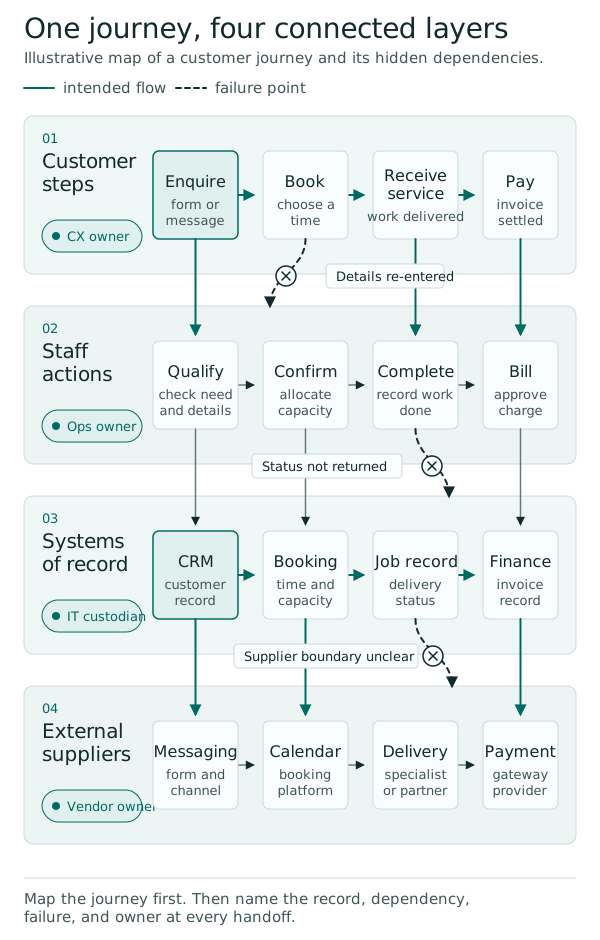
Layer 1: Customer step
Write what the customer experiences: submits an enquiry, receives a reply, selects a time, receives service, and receives an invoice. This layer stops the exercise becoming an internal software discussion. Every lower layer should support a visible customer or business outcome.
Layer 2: Staff action
Record the action and role, not only a department. “Coordinator checks availability” is clearer than “Operations.” Add manual checks, copy-and-paste work, approvals, follow-up messages, and recovery steps. Check these details against actual records because formal procedures may omit them.
Layer 3: System of record
Name where the authoritative version of each key fact should live. The CRM may own contact details, booking may own appointment status, and accounting may own the invoice balance. Mark a conflict if two systems both appear authoritative.
Layer 4: External supplier
Show every outside service that carries or changes the workflow. Include form hosting, messaging, booking, payment, email delivery, identity, and integration services. Also show any outside party that administers an account.
The following illustrative map traces an enquiry-to-invoice journey. It represents a common service-business pattern, not a named client or measured result.
| Stage | Customer step | Staff action and owner | System of record | Supplier | Failure arrow |
|---|---|---|---|---|---|
| Enquiry | Submits form | Coordinator reviews, sales lead owns | CRM contact and consent | Form host | Form → inbox: silent delivery failure |
| Qualification | Answers on WhatsApp | Adviser copies notes, sales lead owns | CRM opportunity | Messaging provider | Chat → CRM: incomplete re-entry |
| Booking | Chooses time | Coordinator confirms, operations lead owns | Booking status | Booking platform | CRM → booking: identity differs |
| Delivery | Receives service | Practitioner closes job, service lead owns | Delivery record | Service platform | Booking → delivery: cancellation missing |
| Invoice | Receives invoice | Finance checks details, finance lead owns | Invoice and payment status | Accounting provider | Delivery → finance: billing details missing |
Read each column vertically, then each row horizontally. Vertical reading checks consistency within a layer. Horizontal reading tests whether one stage can reach the next without hidden memory or duplicate handling.
How should failure arrows and ownership labels work?
In 2025, just 7% of businesses reviewed risk across their wider supply chain, according to the UK Department for Science, Innovation and Technology, Cyber Security Breaches Survey 2025. Failure arrows and ownership labels expose boundaries that a simple application landscape map for a small business would conceal.
Draw a failure arrow whenever information moves to a new person, format, or system. Label the object crossing that boundary, such as booking status or invoice details. Add the expected trigger and the confirmation someone can observe.
“Completed appointment → invoice queue” remains vague. A better label says, “Practitioner marks complete by 17:00; finance queue shows the job by 17:05.” You can now ask who acts when the confirmation does not appear.
Use three ownership labels. The action owner performs or checks the work. The record owner decides what the data means and where it belongs. The supplier owner manages the commercial and support relationship.
If the map exposes missing decision rights, use a business systems ownership model to resolve them. The map should expose the gap without assigning responsibility to whoever happens to be most technical.
A failure arrow is useful before an incident occurs because it records where certainty ends. That makes a system dependency map valuable during staff leave, supplier changes, recovery, and ordinary reviews.
What should the map reveal without redesigning the business?
In 2025, board-level cyber responsibility existed in 27% of businesses, down from 38% in 2021, according to the UK Department for Science, Innovation and Technology, Cyber Security Breaches Survey 2025. Your map should reveal ownership gaps and dependencies, but it should not prescribe the future design.
Don’t fix the diagram while mapping it. Moving boxes into a cleaner arrangement can hide the real as-is state. Keep awkward steps, manual work, and duplicate records visible. Mark assumptions separately, then verify them.
The map cannot decide whether software should stay. That belongs in a separate integrate-versus-replace assessment, where fit, cost, risk, and migration consequences can be considered properly.
Likewise, don’t rank integration work here. Once the current state is agreed, a business systems integration plan can sequence changes. The documented systems cleanup and handoff case study also shows why preserving access, decisions, and operating context matters. That case study does not promise a measured result for your business.
Frequently asked questions
In 2025, the UK government’s survey covered 2,180 businesses and 44 in-depth interviews, according to the Department for Science, Innovation and Technology, Cyber Security Breaches Survey 2025. That evidence base suits a broad mapping exercise: cover governance, suppliers, people, and recovery, not software boxes alone.
How detailed should a business systems map be?
Map enough detail to follow one record through the journey. In 2026, the UAE service-sector SME definition reaches 200 employees, according to the UAE Government, Small and Medium Enterprises. Begin with roles, records, boundaries, and owners. Add field-level detail only when a failure depends on it.
Should we map every application?
No. Start with applications used by the chosen journey. In 2025, 14% of businesses reviewed immediate-supplier risks in the UK Department for Science, Innovation and Technology, Cyber Security Breaches Survey 2025. Include another application when it holds key data, controls access, moves information, or creates a supplier dependency.
Who should attend the mapping session?
Include people who perform, approve, support, and recover the work. In 2025, 19% of businesses provided cyber training or awareness activities, according to the UK Department for Science, Innovation and Technology, Cyber Security Breaches Survey 2025. Staff participation matters because written procedures rarely capture every check and workaround.
How often should the map be updated?
Update it after a material workflow, supplier, access, or ownership change. In 2025, 53% of small businesses had continuity plans addressing cyber security, according to the UK Department for Science, Innovation and Technology, Cyber Security Breaches Survey 2025. Review it periodically against a real journey, not only a calendar date.
Keep the map as a controlled operating record
In 2025, 48% of small businesses conducted cyber risk assessments, up from 41% in 2024, according to the UK Department for Science, Innovation and Technology, Cyber Security Breaches Survey 2025. A maintained map gives those reviews a concrete view of systems, suppliers, data, and responsibility.
Store the map where operational owners can reach it. Give it a named owner, review date, scope, and change note. Link supporting records without putting credentials or customer data inside the map.
Return to the wider guide on connecting fragmented business systems when you need to place these findings in the full diagnosis. The map is the as-is evidence. Future sequencing, integration, and replacement decisions come afterward.
Sources
- UAE Government, Small and Medium Enterprises, updated 24 April 2026, retrieved 2026-07-16, https://u.ae/en/information-and-services/business/small-and-medium-enterprises
- UK Department for Science, Innovation and Technology and Home Office, Cyber Security Breaches Survey 2025, updated 19 June 2025, retrieved 2026-07-16, https://www.gov.uk/government/statistics/cyber-security-breaches-survey-2025/cyber-security-breaches-survey-2025