Why Is My Team Entering the Same Information Twice?
Find where duplicate data entry begins, measure the repeated work, and decide which business-system handoff to correct first in your UAE business today.
Duplicate data entry begins when a business handoff has no dependable route. One system collects the information, another needs it, and the team closes the gap by copying fields. Staff have become the connection between tools. That pattern often points to disconnected business systems, even when each tool works correctly on its own.
In 2023, 64% of workers said they lacked enough time and energy to do their jobs, according to Microsoft’s Will AI Fix Work? report (Microsoft Work Trend Index, 2023). The figure isn’t a measure of re-entry. It shows why repeated administrative work deserves evidence, rather than another reminder to be careful.
This guide shows how an owner can locate manual data re-entry, record it consistently, and choose the first handoff to correct. It doesn’t assume every repeated field needs automation. Some repetition is a useful control. The aim is to distinguish that control from avoidable copying between systems.
Key Takeaways
- Duplicate entry usually exposes a broken handoff. Poor discipline is rarely the source.
- In 2023, 62% of surveyed workers struggled with time spent searching for information (Microsoft Work Trend Index, 2023).
- A Re-entry Ledger makes frequency, corrections, and ownership visible.
- Correct the highest-risk handoff, not simply the most irritating one.
Why does duplicate data entry begin?
In 2023, 62% of Microsoft’s 31,000 survey respondents said they struggled with too much time spent searching for information, according to Will AI Fix Work? (Microsoft Work Trend Index, 2023). Duplicate entry begins when staff must find, interpret, and move information because systems share no trusted handoff.
Repetition becomes more expensive when fields mean different things. “Customer name” might mean a person in the form, a company in the CRM, and the legal billing entity in accounting. Those definitions can each be valid at different stages. A direct connection would only move the inconsistency faster. Before connecting anything, define what the field means and which system can change it.
Staff become the integration layer when they must remember routes, formats, exceptions, and timing. The workflow depends on knowledge that nobody assigned to a system. Training can make the copying more consistent, but it cannot remove the handoff.
How can you find where the same data is entered multiple times?
In 2023, Microsoft 365 activity showed employees spending 57% of their measured time communicating and 43% creating, according to Will AI Fix Work? (Microsoft Work Trend Index, 2023). Find re-entry by following one real transaction across people and tools, rather than asking which application causes the most complaints.
Start with a customer event that has a clear beginning and end. An enquiry-to-invoice journey works well because it crosses sales, delivery, and finance. Sit beside the people doing the work. Record what they receive, what they type, where they look for missing details, and what happens when information is wrong.
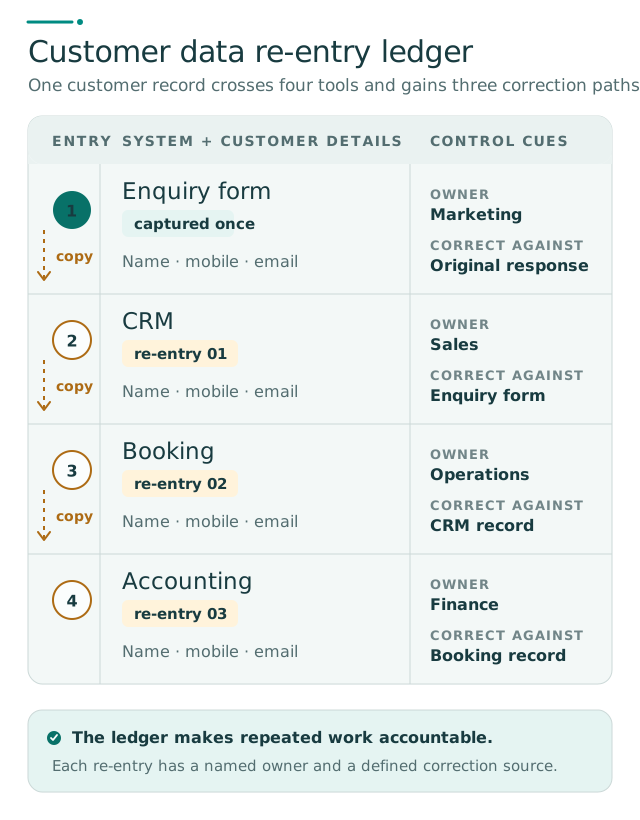
This illustrative workflow represents a UAE service business, not a named client or measured result. The business receives an enquiry through a form, qualifies it in a CRM, schedules the work in a booking tool, and raises an invoice in accounting software.
Build a Re-entry Ledger
| Field | Source | Destination | Weekly repetition | Correction path | Accountable owner |
|---|---|---|---|---|---|
| Customer name | Website form | CRM | Count each copied record | Check form submission, then correct CRM contact | Sales owner |
| Mobile number | CRM | Booking tool | Count each scheduled customer | Confirm with customer, then update both systems | Operations owner |
| Service address | CRM | Booking tool | Count each new booking | Check original enquiry, then correct booking | Operations owner |
| Legal billing name | CRM | Accounting system | Count each first invoice | Confirm trade licence or customer instruction | Finance owner |
| Invoice reference | Accounting system | CRM | Count each issued invoice | Verify invoice, then update CRM record | Finance owner |
In practice, the correction path often reveals more than the initial copy. One wrong mobile number may lead to a failed confirmation, a WhatsApp check, a CRM change, and another booking update. The ledger should record that recovery path, not just the first keystroke.
Run the trace twice: once for a clean transaction and once for a correction. The clean path shows routine repetition. The correction reveals calls, messages, and decisions that staff may forget to mention because recovery feels normal. Comparing both paths shows where the workload actually grows.
A broader business systems audit checklist helps when the trace exposes unclear access, renewals, suppliers, or recovery duties. Keep this exercise narrower when the issue is simply the same field crossing several tools.
How should a duplicate data entry business problem be measured?
In 2023, 68% of respondents said they lacked enough uninterrupted focus time, according to Microsoft’s Will AI Fix Work? report (Microsoft Work Trend Index, 2023). Measure repeated entry through observable events: copies, corrections, interruptions, waiting, and customer-facing failures. Don’t begin with a guessed monetary saving.
Record corrections separately from routine copies. For each one, note where staff found the problem and who verified the original. List every system they updated and whether the customer had to answer again. This creates a practical baseline without inventing a productivity benchmark.
Use a tally for each event during the week. Add a short note when recovery takes an unusual route, such as checking WhatsApp after the CRM record proves wrong. The ledger needs enough detail to explain the interruption, not a minute-by-minute account of somebody’s day.
Recovery exposure often tells an owner more than minutes saved. A frequently copied internal note may be annoying but easy to fix. A rarely copied legal billing name may delay payment or create a document that finance must cancel and reissue. Frequency shows volume. The correction path shows consequence.
When repeated entry also makes CRM, finance, and operations totals disagree, use the four tests for conflicting business reports. The ledger locates movement. Reconciliation determines which definition, owner, cut-off, and source should govern the number.
A published service-business rebuild can help owners see how a customer journey crosses website, booking, and CRM boundaries. Use it as a structural example, not as a benchmark for your own volumes or savings.
Which handoff should you correct first?
In 2023, 60% of people said they lacked the capabilities needed to complete their work, according to Microsoft’s Will AI Fix Work? report (Microsoft Work Trend Index, 2023). Correct the handoff where repeated effort, correction risk, customer impact, and clear ownership meet. High frequency alone is not enough.
Score each ledger row with four plain questions. How often does the field move? What happens when it is wrong? How hard is recovery? Who can approve a change? A candidate with no accountable owner is not ready, even if everyone agrees it wastes time.
Next, confirm the source of truth. The form may be the first source, but the customer record may become authoritative after staff verify it. Accounting may own the legal billing name, while operations owns the service address. One system does not need to own every field.
Ask whether the correction needs a technical connection at all. Removing an unused field, changing a form label, or stopping an unnecessary copy can solve the problem more safely. Sometimes a controlled import is enough. A live integration makes sense only when the handoff is stable and its exceptions are understood.
If a connection is justified, define field ownership, validation, failure alerts, retries, and the manual recovery route before selecting a tool. The CRM and booking integration service describes that implementation boundary. This diagnosis should come first, because connecting an unclear workflow can preserve the wrong rule.
Frequently asked questions
In 2023, Microsoft’s Will AI Fix Work? drew on 31,000 workers across 31 markets (Microsoft Work Trend Index, 2023). Its global findings are context, not a UAE benchmark. Your ledger supplies the local evidence needed to answer the following questions for one business.
Is entering the same information twice always a problem?
In 2023, Microsoft’s Will AI Fix Work? found 62% struggled with search time (Microsoft Work Trend Index, 2023). No. A second entry may be an approval or verification. It becomes a systems problem when staff reproduce trusted information without adding judgment. Record its purpose and owner before removing it.
Can training reduce duplicate data entry?
In 2023, Microsoft’s Will AI Fix Work? found 60% lacked needed capabilities (Microsoft Work Trend Index, 2023). Training can improve formats and missed steps, but it cannot remove copying between disconnected tools. Change the workflow when the standard path still depends on memory or repeated typing.
Who should own the Re-entry Ledger?
In 2023, Microsoft’s Will AI Fix Work? found 68% lacked uninterrupted focus time (Microsoft Work Trend Index, 2023). Assign the ledger to the person accountable for the end-to-end outcome. Sales, operations, and finance can still own their fields. One named person should coordinate decisions across those boundaries.
What should the owner do next?
In 2023, the heaviest 25% of email users spent 8.8 hours weekly in email, according to Microsoft’s Will AI Fix Work? report (Microsoft Work Trend Index, 2023). Your business needs its own evidence. Trace one ordinary enquiry to invoice, then maintain the ledger for a full week.
Start with the field whose correction path carries the clearest business consequence and has a named owner. Remove unnecessary collection before adding a connection. Preserve deliberate checks. Define the source of truth and recovery route before changing how data moves.
The wider guide to why business tools stop working as one system places this re-entry trace beside reporting, ownership, mapping, and supplier handoffs. Use that broader view if the ledger exposes more than duplicate entry. A dependable handoff gives staff and customers a result they can trust, even when the keystroke count barely changes.
Sources
- Microsoft, Will AI Fix Work? 2023 Work Trend Index Annual Report, retrieved 2026-07-16, https://www.microsoft.com/en-us/worklab/work-trend-index/will-ai-fix-work