Business Systems Integration Plan: What Should You Connect First?
Prioritise business-system integrations by impact, frequency, risk, sensitivity, dependency, and ownership before starting another systems project in the UAE.
A business systems integration plan should begin with the handoff that creates the greatest business exposure, rather than the task people complain about most. In 2025, 43% of UK businesses identified a cyber breach or attack, according to the UK Cyber Security Breaches Survey 2025. Use this as a risk benchmark; it does not estimate UAE prevalence.
First, see the wider chain. A map of disconnected business systems shows each handoff, failure owner, and supplier-controlled connection. Without that view, integration can simply speed up a bad process.
This guide assumes you have chosen which systems to keep. It helps you compare handoffs, choose the first connection, and sequence the work.
Key Takeaways
- Score each handoff on frequency, impact, recovery exposure, sensitivity, dependency, and ownership.
- Treat a missing owner as a stop condition.
- Only 14% of UK businesses reviewed immediate-supplier cyber risk in 2025, according to the UK Cyber Security Breaches Survey 2025.
- Connect the highest-exposure ready handoff before the loudest irritation.
What should a business systems integration plan do first?
In 2025, only 14% of UK businesses formally reviewed cyber risk from immediate suppliers, according to the UK Cyber Security Breaches Survey 2025. Define the handoff, its owner, and its supplier dependencies before ranking any technical connection. This gate keeps an attractive technical fix from outrunning a business decision.
Next, map the software and handoffs behind the journey. Record the trigger, required fields, system of record, and receiving system. Add the exception path and accountable person. An unclear current path is not ready for integration.
The first connection puts a governance decision into software. It determines which event counts, which record wins, and who acts after failure. The business owner must make those decisions before a supplier starts configuration.
The transparent priority equation
In 2025, board-level responsibility for cyber security fell to 27% of UK businesses, from 38% in 2021, according to the UK Cyber Security Breaches Survey 2025. A transparent equation keeps ownership visible. It prevents urgency or a supplier’s preferred project from quietly deciding the roadmap.
Score each factor from 0 to 5 using current-workflow evidence. Apply the same interpretation to every candidate.
| Factor | What the score means |
|---|---|
| F, frequency | 0 is rare; 5 is many times each working day. |
| I, impact | 0 is negligible; 5 means revenue, service, or statutory work can stop. |
| R, recovery exposure | 0 is easy to correct; 5 is hidden, costly, or hard to reverse. |
| S, sensitivity | 0 is public data; 5 covers tightly controlled personal, health, financial, or credential data. |
| D, dependency | 0 is ready; 5 is blocked by major process, data, contract, or access work. |
| O, owner readiness | 0 means no owner; 3 means proposed; 5 means accepted. |
Use this equation:
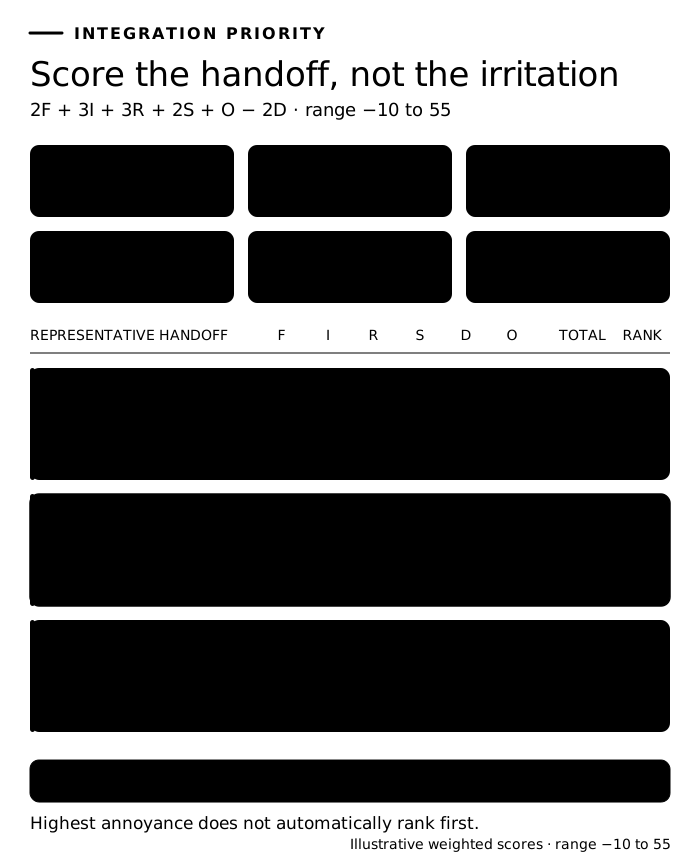
Priority score = (2 × F) + (3 × I) + (3 × R) + (2 × S) + O - (2 × D)
Scores range from -10 to 55. Impact and recovery carry the largest weights because either can stop service or make failure costly to unwind. Dependency lowers the total when essential foundations are missing.
Ownership acts as both a score and a gate. If O = 0, implementation stops, regardless of the total. The named owner must be able to define the outcome, accept the risk, and resolve competing supplier advice. A name without that authority does not open the gate.
The UAE’s Personal Data Protection Law covers electronic personal-data processing inside and outside the country. The Official Platform of the UAE Government explains duties concerning security, confidentiality, data-subject rights, and cross-border transfers. Sensitivity therefore belongs in the design from the start.
Why is the most annoying handoff not always first?
In 2025, surveyed UK businesses reported an average £1,600 cost for their most disruptive breach, according to the UK Cyber Security Breaches Survey 2025. Cost and recovery exposure can outweigh the repeated nuisance that dominates daily conversation. The equation exposes that difference before the team commits its time.
Consider three illustrative UAE service-business handoffs. These representative inputs demonstrate the equation without presenting client results or measured benchmarks.
| Candidate handoff | F | I | R | S | D | O | Score |
|---|---|---|---|---|---|---|---|
| Copy booking details into the CRM | 5 | 2 | 1 | 2 | 0 | 5 | 28 |
| Pass confirmed payment status to delivery | 3 | 5 | 5 | 4 | 2 | 5 | 45 |
| Reconcile the monthly finance report | 1 | 4 | 3 | 4 | 1 | 3 | 32 |
The booking copy is visible and recoverable. Payment failure can release unpaid work, delay paid work, or expose sensitive financial details.
Payment comes first if ownership is accepted and dependencies can be cleared. The monthly report ranks second. Booking ranks third, despite its frequency.
The gap matters more than the exact totals. Record operational evidence for each score revision. A recent incident, signed dependency, or confirmed owner can justify a revision. General confidence cannot.
Annoyance measures visibility rather than exposure. Quiet failures can affect revenue, access, compliance, or recovery without generating staff complaints. The equation makes those consequences comparable while leaving the decision with the workflow owner.
What belongs in an integration requirements checklist?
In 2025, 68% of surveyed UK businesses restricted administrative rights, while 40% used two-factor authentication, according to the UK Cyber Security Breaches Survey 2025. Requirements need to cover access and failure control alongside the records moving between tools. Otherwise, a working data transfer can still leave the business unable to detect or recover a fault.
For each shortlisted handoff, record the following before requesting estimates or implementation details:
- the business event and intended finish state.
- the source of truth, receiving system, and required records.
- permitted delay, duplicate rules, and retry behaviour.
- data sensitivity, account ownership, and minimum access.
- validation, alerts, response time, and recovery steps.
- supplier dependencies, acceptance evidence, and named business owner.
Could a reliable person perform the handoff safely at its present volume? If yes, the connection may rank below a broken decision or unreliable source record. The guide on when not to automate a business process helps test that boundary before software makes the problem harder to see.
For CRM and booking handoffs that have passed this decision stage, the CRM and booking integration scope shows the kind of implementation work that may follow. This plan stops earlier. It establishes priority and requirements before any tool selection or sale.
How do you turn scores into a business systems integration plan?
In 2025, 48% of surveyed UK small businesses conducted cyber risk assessments, up from 41% in 2024, according to the UK Cyber Security Breaches Survey 2025. A roadmap needs routine reassessment because risk, ownership, and dependencies change. Each score records a dated decision and should change when the evidence changes.
Sequence the first ready connection, then schedule the enabling work for a higher-value blocked connection. Suppose customer identifiers are inconsistent across systems. The roadmap may first define and clean those identifiers. It can then connect payment status to delivery. Calling both items “integration” hides the dependency.
Set an acceptance condition in business language. For example: “Every confirmed payment updates the matching delivery record once, within five minutes. A failed match alerts finance without releasing delivery.” The statement makes success observable without turning the plan into a code specification.
In our experience, sequencing fails when a roadmap ends at launch. The plan also needs an owner for monitoring, a regular exception review, and a recovery rehearsal. Record the supplier renewal as well. These duties keep the connection dependable after the original implementer moves on.
Record what another supplier would need to operate or replace the connection. The technology handover checklist covers access, configuration, data flows, backups, suppliers, incidents, and open risks. Including portability in the requirements prevents a rushed exit scramble later.
Review scores after a material workflow, supplier, legal, or data change. Also review them before approving the next connection. A software integration roadmap controls a sequence of decisions instead of preserving a fixed queue of requested automations.
Frequently asked questions
In 2025, 53% of surveyed UK small businesses had cyber continuity plans, up from 44% in 2024, according to the UK Cyber Security Breaches Survey 2025. The questions below test whether a proposed first connection has an accountable owner and a credible recovery path.
How many integrations should a UAE SME start at once?
Start with one business-critical handoff unless two connections share the same source, owner, and recovery path. In 2025, only 14% of surveyed UK businesses reviewed immediate-supplier cyber risk, according to the UK Cyber Security Breaches Survey 2025. A smaller scope makes supplier responsibilities and recovery easier to inspect.
Should frequency carry the highest weight?
No. Frequency reveals labour, but impact and recovery deserve more weight. Surveyed UK businesses put the average cost of their most disruptive breach at £1,600 in 2025, according to the UK Cyber Security Breaches Survey 2025. A monthly payment or access failure can matter more than reversible daily copying.
What if the highest-scoring integration has no owner?
Treat it as blocked. Only 27% of surveyed UK businesses assigned board-level cyber responsibility in 2025, down from 38% in 2021, according to the UK Cyber Security Breaches Survey 2025. The owner needs documented authority before the team rescores readiness.
When should the plan be reviewed?
Review it after changes to process, data, suppliers, law, access, or business impact. In 2025, 48% of surveyed UK small businesses conducted cyber risk assessments, according to the UK Cyber Security Breaches Survey 2025. Regular reassessment keeps an old score from becoming false certainty.
What should you do next?
In 2025, only 7% of surveyed UK businesses reviewed cyber risk across their wider supply chain, according to the UK Cyber Security Breaches Survey 2025. The next step is to score real handoffs with their owners and supplier dependencies in the room. That conversation tests whether the written ownership gate has practical authority.
A working session can begin with three candidates from one customer journey. The group defines each start event and finish state before scoring all six factors, then records the evidence behind every score. Any candidate without a named owner stops at the gate, even if its total would otherwise put it first.
The winning candidate should be valuable, ready, observable, and recoverable. Frequency alone does not put it first. For the broader diagnosis behind that choice, return to the guide on why business systems stop talking to each other. That context keeps the first connection tied to the whole business rather than one isolated tool.
Sources
- UK Department for Science, Innovation and Technology and Home Office, Cyber Security Breaches Survey 2025, retrieved 2026-07-16, https://www.gov.uk/government/statistics/cyber-security-breaches-survey-2025/cyber-security-breaches-survey-2025
- The Official Platform of the UAE Government, Data protection laws, retrieved 2026-07-16, https://u.ae/en/about-the-uae/digital-uae/data/data-protection-laws