Why Your Business Systems Don’t Talk to Each Other
Learn why business systems become disconnected, how to trace broken handoffs, and what an owner-led UAE business should fix before buying another tool.
Disconnected business systems can leave you joining a business together by hand even when every tool appears to work. The failure rarely begins with a dramatic outage. It grows one reasonable decision at a time: a form for enquiries, WhatsApp for replies, booking software for appointments, a CRM for opportunities, and accounting software for invoices.
The gaps appear between those tools. Staff copy details, settle conflicting numbers, chase missing updates, and remember exceptions. A spreadsheet becomes the report you trust because no system shows the complete journey.
This guide traces those gaps before another purchase makes them harder to see. It follows one representative UAE service-business enquiry from first contact to reporting. Every step is illustrative. It describes neither a named client nor a measured result.
Key Takeaways
- Disconnection usually sits in handoffs, ownership, and definitions, not simply in software.
- A 2025 UAE enterprise survey found fragmented technology and poor vendor interoperability challenged 37% of respondents (IDC, “The Rise of Agentic AI in the GCC”, 2025).
- Trace one customer journey before changing tools.
- Fix the highest-risk handoff with a named owner and recovery route.
Why do business systems become disconnected?
Business systems become disconnected when local tool decisions outrun ownership of the complete workflow. In 2026, the UAE Ministry of Economy and Tourism reported more than 1.4 million operating companies. Its register work linked integration with accurate and reliable data sharing (UAE Ministry of Economy and Tourism, “Economic Integration Committee explores developments in the country’s business and investment environment amid current circumstances”, 2026).
Disconnected systems cannot pass trustworthy information to each other without manual help. Sometimes a missing technical connection causes the gap. Sometimes two teams disagree about what a “confirmed booking” means.
Software usually enters a business to solve the problem directly in front of one team. Sales gets a CRM, operations gets scheduling, and finance gets invoicing. Marketing adds forms and campaign data. Each decision can make sense alone, while the customer journey across them remains undesigned.
Supplier changes create another route to fragmentation. One vendor owns the website form, another configures the CRM, and a third maintains accounting software. Each sees its own boundary. You experience the whole workflow, but nobody owns it.
Tool count alone tells you little. Ten systems with clear roles can cooperate better than three with ambiguous ones. Check whether every important record has an owner, every handoff has a rule, and every failure has a recovery path.
Replacing one application often disappoints for the same reason. The new product enters the old workflow and inherits its uncertain definitions and responsibilities. A current-state business systems audit gives you evidence before another purchase adds another boundary.
What does the Disconnected Systems Failure Chain look like?
In 2025, an IDC survey commissioned by AWS and e& found that fragmented technology and poor vendor interoperability challenged 37% of 70 UAE respondents (IDC, “The Rise of Agentic AI in the GCC”, 2025). These were organizations with more than 100 employees, so the figure is enterprise context, not a UAE SME benchmark.
The Disconnected Systems Failure Chain traces where a customer journey changes hands. It records what the customer did, what staff did, the system record, the owner, and the delay. It also marks every recovery route and manual re-entry. One broken step may seem small. Connected failures can leave the final report impossible to trust.
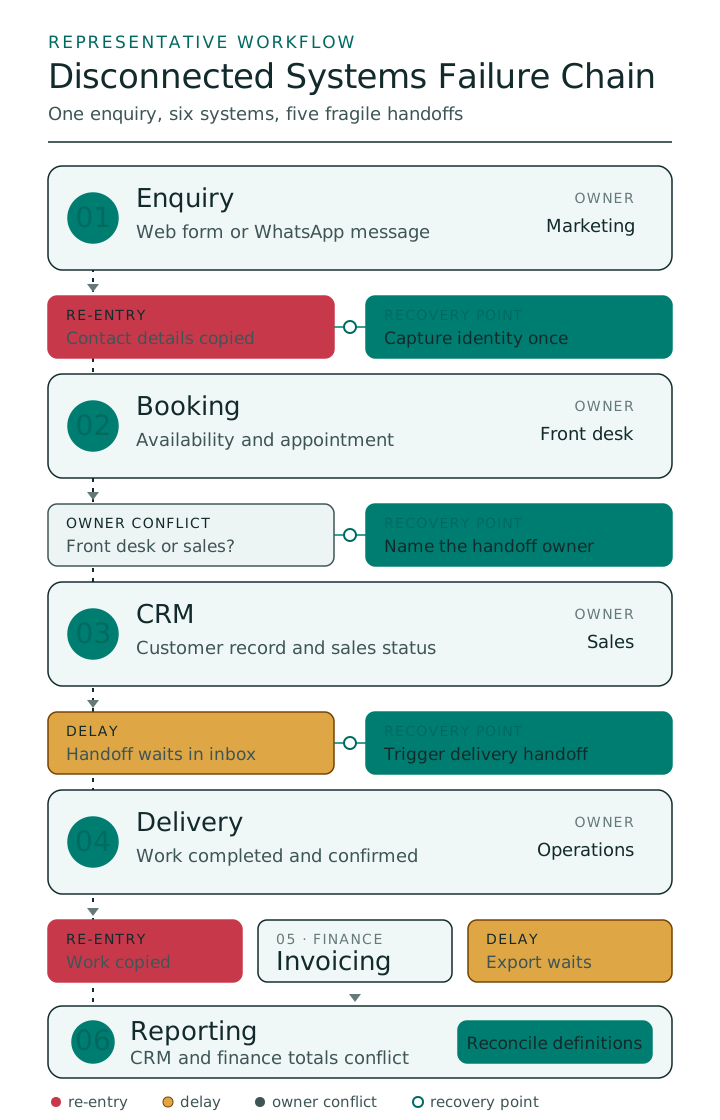
1. Enquiry arrives through a form or WhatsApp
Consider an illustrative Dubai service business receiving one enquiry through its website form. Another customer sends a similar request through WhatsApp. The form emails a shared inbox, while the message reaches a staff member’s phone. Neither channel creates a complete CRM record automatically.
Re-entry begins when a coordinator copies the customer’s name, phone number, requested service, and preferred date into the CRM. The coordinator shortens the WhatsApp wording and omits the form’s campaign source. The delay lasts until someone checks both channels, so a message received during delivery work may sit unseen.
The ownership conflict spans three teams. Marketing owns the form, sales owns the CRM, and operations answers WhatsApp. Nobody owns receipt through assignment. Recovery relies on a daily inbox check, staff availability, memory, and access to the right phone.
This creates the first split. The customer thinks one conversation has started, while the business holds partial versions of it. A practical ledger for repeated data entry shows which fields staff copy and where corrections travel.
2. Booking creates a second customer record
The coordinator qualifies the enquiry and opens the booking tool. The customer’s details are typed again because booking and CRM use different fields. The CRM says “qualified,” while booking says “provisional.” Neither status controls the other.
Re-entry moves contact details, service choice, location, price, and appointment notes from CRM to booking. A building-access note stays in WhatsApp. The delay then depends on a deposit, customer confirmation, or team availability. Each condition lives in a different place, so nobody sees one dependable booking state.
The ownership conflict begins when sales treats a proposed slot as an operations matter. Operations treats it as a sales matter until payment arrives, while finance sees the deposit later. Recovery comes from a calendar reminder that prompts someone to compare the CRM, booking tool, and WhatsApp thread. The record gets repaired. The process doesn’t.
The customer may receive two messages with different times or wording. Staff may promise a slot that operations hasn’t confirmed. A CRM and booking integration can help only after the business defines which system owns each status.
3. CRM status stops reflecting reality
Delivery staff prepare the service from the booking tool and rarely open the CRM. Sales therefore sees the opportunity at “booked” after the customer reschedules, cancels, or completes the work.
Re-entry happens when the coordinator notices the mismatch and updates the CRM. Notes may arrive from a booking comment or WhatsApp days later. Until then, stale information drives follow-up. One customer may receive a sales reminder after completing the service. Another may get none because the booking change never reached sales.
The ownership conflict sits between relationship history and delivery status. Sales owns the first, operations owns the second, and nobody translates between them. A weekly pipeline meeting provides recovery by finding obvious exceptions. The team corrects those records, but the next booking follows the same path.
4. Delivery creates information that never travels back
The team completes the service and records practical notes in its delivery tool. Those notes might cover added work, a customer request, materials used, or a follow-up commitment. Finance and sales cannot see them.
Re-entry starts when operations messages finance to adjust the invoice. Sales copies a follow-up note into the CRM if that message reaches the right person. Meanwhile, the invoice waits for confirmation, and the customer waits for the promised follow-up. Management sees “complete” without the detail behind it.
The ownership conflict divides the facts, invoice, and next conversation across three roles. Each assumes another person passed the update onward. A supervisor provides recovery by comparing completed jobs with the team chat. That review catches costly omissions, while smaller inconsistencies remain.
5. The invoice starts from an incomplete version of delivery
Finance raises an invoice from the booking price or a message from operations. The accounting system creates another customer record when names, phone numbers, or company details don’t match the CRM format.
Re-entry covers customer details, line items, VAT information, discounts, and payment terms. A corrected company name may never return to the CRM. The delay begins when finance asks operations to confirm extras. Operations checks delivery notes, sales checks the original promise, and the invoice stays in draft.
The ownership conflict leaves finance controlling the accounting record without authority over what the customer bought. Sales owns the promise but not the delivered variation. Recovery reaches the owner, who reads the message history and resolves the disagreement. The invoice goes out, but the decision remains undocumented.
6. Reporting combines records that describe different moments
At month end, the owner receives a CRM pipeline report, a booking export, an accounting report, and an operations spreadsheet. Each can be internally correct while answering a different question or using a different cut-off time.
Re-entry occurs when someone copies totals into a management spreadsheet and adds adjustments without links to the original records. The delay can last days. By the time the team agrees on a number, the underlying records have changed again.
The ownership conflict hides inside definitions. Sales counts a booking when the customer confirms. Operations counts it when a slot is assigned, while finance counts revenue when an invoice is posted. The owner sees three numbers called “bookings” or “sales.” A meeting supplies temporary recovery by choosing one number for the month.
The same debate returns unless the team records the definition, source, cut-off, and owner. Declaring one application the universal truth won’t solve a disagreement about meaning. The four tests for conflicting business reports separate a definition problem from a timing or source problem.
How can you recognise disconnected business systems?
You can recognise disconnected systems when staff carry context between tools or settle routine disagreements by hand. In 2025, IDC studied 226 GCC organizations with more than 100 employees, including 70 in the UAE (IDC, “The Rise of Agentic AI in the GCC”, 2025). That enterprise evidence cannot measure SME lead leakage, but it confirms interoperability as a live regional concern.
Common signs include:
- Staff copy the same customer, booking, or invoice details more than once.
- A person must check two systems before answering a simple customer question.
- Team meetings exist mainly to reconcile statuses rather than make decisions.
- Reports disagree, and nobody can explain the definition or cut-off behind each number.
- One employee’s phone, inbox, spreadsheet, or memory connects the workflow.
- Customer updates depend on someone noticing that another tool changed.
- Suppliers can inspect their own component but cannot explain the whole journey.
- The owner resolves routine disputes about what happened and what happens next.
A four-layer map of software and handoffs makes hidden dependencies visible. It shows customer steps, staff work, systems of record, suppliers, failure points, and owners without starting a technology project.
What do fragmented systems really cost?
Fragmented systems cost a business through repeated work, delayed cash, unreliable decisions, and recovery tied to staff memory. In 2026, the UAE Ministry reported more than 1.4 million operating companies (UAE Ministry of Economy and Tourism, “Economic Integration Committee explores developments in the country’s business and investment environment amid current circumstances”, 2026). That source measured no losses inside private companies, so it provides no UAE cost benchmark here.
Hidden costs appear in five places. Re-entry and recovery consume attention, while conflicting numbers weaken decisions. Missing context makes customer service inconsistent. Undocumented dependencies raise the risk of change. Divided supplier boundaries send routine resolution back to the owner.
Counting minutes captures only part of the effect. A delayed invoice is visible, while an unreliable pipeline is harder to price. The business may hire, spend, or defer a decision using records that describe different moments.
To estimate hidden cost without inventing a benchmark, record actual events for four weeks:
- Count each repeated entry, reconciliation, chase, correction, and owner escalation.
- Record which customer or transaction caused it.
- Note the roles involved and elapsed delay, not only hands-on time.
- Mark whether the failure affected service, cash, reporting, or risk.
- Identify whether recovery relied on documented steps or personal knowledge.
This produces business evidence rather than a generic calculator. For broader commercial comparisons, use the separate guide to the real cost of a UAE technology agency rather than mixing supplier pricing into a systems diagnosis.
What should you fix before buying another tool?
In 2025, IDC’s UAE interoperability result came from 70 organizations with more than 100 employees (IDC, “The Rise of Agentic AI in the GCC”, 2025). That context cannot prescribe an enterprise programme for an owner-led business. Trace one customer journey and fix its governing rule before selecting technology.
For each step, write down:
- what event starts the step
- what information must be present
- where the authoritative record lives
- who can decide its status
- which person or system receives it next
- how the receiver knows it arrived
- what happens when it fails
- how the business confirms recovery
Then mark every re-entry, delay, conflicting owner, and recovery point. Do not label a workaround as an integration. If a coordinator checks an inbox every morning, record a human check with a time dependency.
Next, choose one handoff by business consequence. Frequency matters, but it is not the only factor. A weekly payment or privacy failure may deserve attention before a daily low-risk copy. The business systems integration plan explains how to compare frequency, impact, recovery exposure, data sensitivity, dependency, and ownership.
Define the rule before the connection. Decide which system creates the record, which fields may change elsewhere, what each status means, and who handles exceptions. Otherwise, an integration can move ambiguity faster.
Fix recovery alongside the normal path. A successful test proves only that the expected case worked once. Ask what staff see when a record fails, who receives the alert, which system remains authoritative, and how a corrected transaction returns to the normal flow.
Should you connect, automate, or replace the systems?
In 2025, 37% of the UAE enterprise respondents cited fragmented technology and poor vendor interoperability (IDC, “The Rise of Agentic AI in the GCC”, 2025). The finding identifies a barrier, not a prescription. The right response may be a connection, process change, replacement, or no technology change.
Connect systems when both tools fit their jobs, the handoff is stable, and the business can name the source record. Integration is useful when it removes repeated transfer without hiding a needed human decision.
Automate a step when the rule is clear, exceptions are understood, and failure is visible. Do not automate a disputed definition or a process that changes every week. The guide on when not to automate a business process covers that decision in depth.
Replace a system when it cannot support the required role, creates unacceptable risk, or makes ordinary change unreasonably difficult. Replacement is not a reward for being annoyed. Compare the current tool, workflow, migration, dependencies, and ownership through the separate integrate-versus-replace decision.
Keep the system unchanged when a connection would cost more or create more risk than the problem justifies. A documented manual control can suit a rare event that needs human judgment. The aim is a dependable complete workflow, and some controls can stay manual.
Who owns the system when several suppliers are involved?
In 2026, the UAE Ministry reported more than 1.4 million operating companies (UAE Ministry of Economy and Tourism, “Economic Integration Committee explores developments in the country’s business and investment environment amid current circumstances”, 2026). The Ministry also linked register integration with accurate and reliable data sharing. Inside a business, ownership must cover decisions, access, incidents, changes, renewals, and recovery.
Assign three distinct roles. The business decision owner defines what the workflow must achieve and settles policy questions. The system custodian controls access and configuration, maintains documentation, and performs routine checks. A supplier may build or maintain one component within a clear boundary.
One person may hold two roles in a small business. The roles still need names. Otherwise, a supplier can reasonably say its component works while the owner faces a broken customer journey.
Use the business systems ownership matrix to divide duties between the decision owner, custodian, and supplier. If a supplier relationship ends, the minimum technology handover checklist protects access, data, configuration, billing, dependencies, recovery knowledge, and open risks.
Businesses with frequently changing workflows may need continuing responsibility across systems. The explanation of a retained technology partner in Dubai covers that separate commercial model without turning ownership into a sales label.
Frequently asked questions
The evidence boundary is simple. In 2025, the 37% result came from 70 UAE organizations with more than 100 employees (IDC, “The Rise of Agentic AI in the GCC”, 2025). The 1.4-million-company figure describes the national register, not CRM re-entry or missed enquiries (UAE Ministry of Economy and Tourism, “Economic Integration Committee explores developments in the country’s business and investment environment amid current circumstances”, 2026).
What are disconnected business systems?
Disconnected business systems cannot exchange complete, trustworthy information without manual intervention. The problem may involve software, definitions, responsibilities, or all three. A workflow is disconnected when staff must repeatedly carry context between tools, reconcile statuses, or recover missing records through personal knowledge.
Do we have too many disconnected systems?
Count boundaries, not subscriptions. Several specialised tools can work well when ownership and handoffs are clear. A smaller stack can still be fragmented if each tool holds a different customer status. Trace one journey and count re-entry, delay, conflicting ownership, and manual recovery before removing software.
Is a single source of truth always one application?
No. One system should normally own each important record or definition, but the whole business can use several authoritative systems. The CRM may own relationship status, booking may own appointment state, and accounting may own posted invoices. The handoff rules must preserve those boundaries.
Can an integration fix bad data?
An integration can transfer data, but it cannot decide which conflicting value is correct without a rule. Agree field meaning, source ownership, validation, exception handling, and recovery first. Otherwise, the connection may distribute errors faster and make their origin harder to see.
Where should an owner start?
Start with one important customer journey and one recent transaction. Follow it from first contact through delivery, payment, and reporting. Record what staff actually do, including messages and spreadsheets. Then choose the handoff with the clearest combination of impact, repetition, risk, and accountable ownership.
A connected business starts with a visible handoff
A connected business starts by making one consequential handoff visible. In 2025, 37% of surveyed UAE enterprises identified fragmented technology and poor vendor interoperability as a challenge (IDC, “The Rise of Agentic AI in the GCC”, 2025). That enterprise finding identifies a barrier, while evidence from your workflow identifies the repair.
In 2026, the UAE Ministry linked integration with accurate and reliably shared register data (UAE Ministry of Economy and Tourism, “Economic Integration Committee explores developments in the country’s business and investment environment amid current circumstances”, 2026). The national-register context supports the principle of dependable exchange. It doesn’t quantify losses or prescribe a system change for an owner-led business.
Disconnected business systems become manageable once you can see where information, responsibility, and meaning break apart. Trace one journey, then mark its re-entry, delays, ownership conflicts, and recovery points. Fix the governing rule and highest-consequence handoff before buying another tool.
Begin the deeper work with an audit of the current systems, followed by a map of the software and handoffs. That sequence turns “our systems don’t talk” into an operating decision the owner can assign, test, and verify.
Sources
- UAE Ministry of Economy and Tourism, “Economic Integration Committee explores developments in the country’s business and investment environment amid current circumstances,” 2026, retrieved 2026-07-16, https://www.moet.gov.ae/en/-/economic-integration-committee-explores-developments-in-the-country-s-business-and-investment-environment-amid-current-circumstances
- IDC, “The Rise of Agentic AI in the GCC,” report commissioned by AWS and e&, October 2025, retrieved 2026-07-16, https://pages.awscloud.com/rs/112-TZM-766/images/25-EMEA-en-US-idc-other-ardm-rise-of-agentic-ai-in-the-gcc-reprint.pdf