Who Owns Your Business Systems When Something Breaks?
Assign clear decision, access, incident, change, renewal, and recovery ownership when one business workflow crosses several systems and suppliers in the UAE.
A business system needs three named roles: a business decision owner, a system custodian, and a supplier for each contracted component. Without that split, ownership disappears when a customer journey crosses a website, CRM, booking tool, payment service, and spreadsheet.
The wider guide to why business systems stop working together explains how these gaps form. Here, the question is who decides, keeps access, and coordinates recovery when several parties are involved.
In 2024, NIST added Govern to the five existing functions in its Cybersecurity Framework 2.0 (NIST, NIST Releases Version 2.0 of Landmark Cybersecurity Framework, 2024). The model treats governance as an operating function, rather than administration.
Key Takeaways
- Business decisions, technical custody, and supplier delivery belong to separate roles.
- In 2024, NIST made governance one of six core cybersecurity functions.
- Assign one accountable decision owner before an incident.
- Record access, change, renewal, and recovery duties separately.
Who should own a business system?
In 2024, NIST described six connected functions in Cybersecurity Framework 2.0, including the new Govern function (NIST, NIST Releases Version 2.0 of Landmark Cybersecurity Framework, 2024). A business system owner should be accountable for business decisions and risk, not merely hold administrator access or maintain one tool.
The custodian knows the accounts, dependencies, configuration, incident contacts, renewal dates, and recovery steps. They maintain that knowledge without deciding commercial priorities.
Assign decision authority to the business owner, working knowledge to the custodian, and delivery obligations within each supplier contract. Calling all three roles the “system owner” leaves staff unsure who can act when a workflow fails.
Why doesn’t a supplier contract settle business systems ownership?
In 2026, Verizon reported that 31% of breaches began with software vulnerabilities in its Data Breach Investigations Report (Verizon Business, 2026 Data Breach Investigations Report, 2026). A supplier may cover the vulnerable product, yet the business must decide urgency, acceptable interruption, customer communication, and fallback operations.
Consider an illustrative service workflow. A form sends an enquiry to a CRM, which triggers a booking message. Finance later raises the invoice. If enquiries disappear, the website supplier may confirm submission while the CRM supplier confirms availability. Both can be correct while the handoff remains broken.
The internal owner authorizes manual follow-up and decides whether to pause a campaign. The custodian gathers evidence from both systems. Those decision and coordination rights should exist before suppliers begin referring the issue to each other.
The same principle applies when the custodian is external. Define the decision boundary before comparing any retained technology partner arrangement. The internal owner must remain named even when another party coordinates the systems.
What does a three-layer application ownership model look like?
A practical application ownership model separates three layers across six recurring duties. In 2024, NIST linked Cybersecurity Framework 2.0 to more than 50 other cybersecurity documents (NIST, NIST Releases Version 2.0 of Landmark Cybersecurity Framework, 2024). That breadth of guidance still cannot replace named decision rights inside one business.
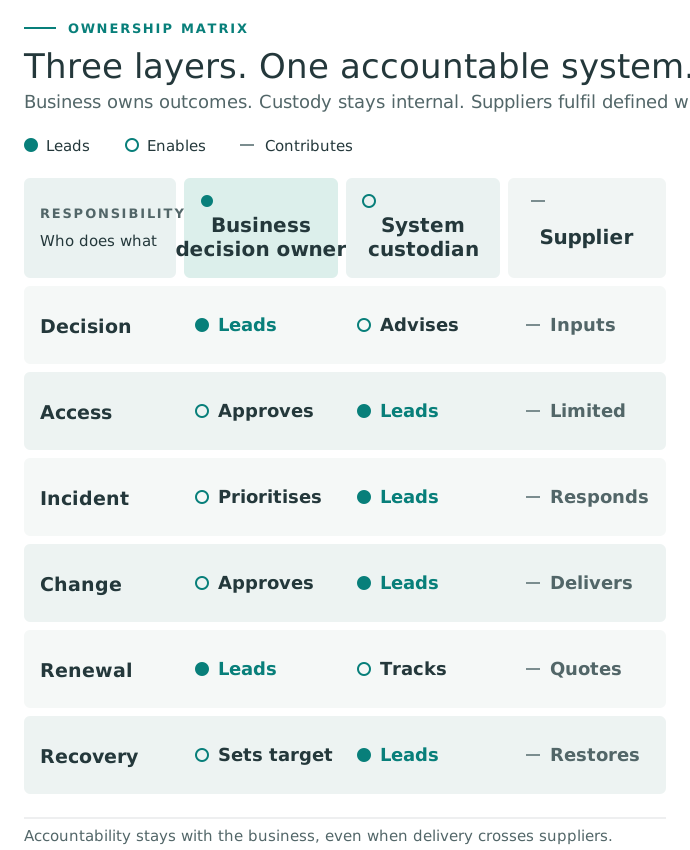
| Duty | Business decision owner | System custodian | Supplier |
|---|---|---|---|
| Decision | Accountable for purpose, priority, risk, and acceptable outcome | Responsible for options, evidence, and dependency advice | Consulted on product limits and effort |
| Access | Accountable for who should have access | Responsible for the access register, reviews, and removal | Responsible for platform controls within scope |
| Incident | Accountable for business priority and customer decisions | Responsible for triage, evidence, coordination, and updates | Responsible for diagnosis and repair within its boundary |
| Change | Accountable for approval and timing | Responsible for impact checks, records, testing, and rollback planning | Responsible for scoped implementation and product advice |
| Renewal | Accountable for spend and continuation | Responsible for dates, usage evidence, dependencies, and notice periods | Consulted on terms, product changes, and cancellation steps |
| Recovery | Accountable for restoration priorities and acceptable loss | Responsible for the recovery plan, contacts, tests, and coordination | Responsible for restoring the contracted component |
The matrix also exposes false ownership. A supplier named in every “responsible” cell may still lack authority to approve downtime or contact customers. Conversely, an owner named everywhere may have authority but no access or operating knowledge.
How should access, incidents, and changes be assigned?
In 2025, the UAE Government’s Data protection laws summary listed four central provisions of the federal Personal Data Protection Law (UAE Government, Data protection laws, 2025). These include correction rights and cross-border transfer requirements. Access and data decisions therefore remain business concerns, even when suppliers operate the software.
Start access ownership with a decision about who needs what. The custodian maintains the account register and removes access when roles change. Each supplier provides the controls available within its platform. You should never have to guess whether another party completed the removal.
Incident ownership needs two clocks. The technical clock tracks diagnosis and repair. The business clock tracks customer impact, manual work, regulatory questions, and operating priorities. The custodian coordinates both, while the decision owner settles trade-offs.
Change ownership begins before implementation. The decision owner approves the outcome and timing. The custodian checks connected systems, records the change, arranges testing, and prepares rollback. The supplier changes only the component inside its agreed scope.
This division prevents a familiar mistake: treating administrator rights as permission to alter the business. An administrator can edit a field or disable a user. Only the authorised decision owner should approve changes that affect customer promises, financial records, or sensitive information.
A current business systems map gives the custodian the dependency view needed for those checks. Without it, even a small change can reach an unexpected supplier or staff handoff.
Who leads escalation when several suppliers are involved?
In 2026, Verizon found that ransomware appeared in 48% of breaches covered by its Data Breach Investigations Report (Verizon Business, 2026 Data Breach Investigations Report, 2026). Whatever the incident type, multi-supplier escalation needs one coordinator, one business decision owner, and defined supplier boundaries before pressure rises.
The custodian should open one incident record. It should capture the observed failure, affected workflow, start time, known changes, and current workaround. Each supplier receives the evidence relevant to its component. The shared record stops separate support threads from producing conflicting accounts.
In our experience, escalation improves when every update states four things: current impact, confirmed evidence, next step, and named owner. This format reduces status calls without pretending the root cause is already known.
The deeper distinction between delivery and continuing accountability is covered in what ongoing systems responsibility means. Keep the immediate escalation model focused on decision rights and evidence.
How do you put a technology responsibility matrix into use?
A technology responsibility matrix works only when staff and suppliers can understand it. In 2024, NIST reported that earlier Cybersecurity Framework versions had been translated into 13 languages (NIST, NIST Releases Version 2.0 of Landmark Cybersecurity Framework, 2024). Write the assignments for their readers, not only for technical staff.
Start with one important workflow, such as enquiry to booking or order to payment. For each system, name the business decision owner and custodian, then record the supplier and a backup. Complete the six matrix rows with people’s names, not departments.
Test the assignments with three short scenarios. Ask who can approve a manual workaround, who can revoke access today, and who coordinates recovery if two suppliers are involved. Any pause, duplicate answer, or unnamed contact reveals a gap.
Review the matrix after a supplier, system, or senior staff member changes. Also check it before a major renewal. The related technology handover checklist shows what access and knowledge must remain under business control when a supplier leaves.
Frequently asked questions about business systems ownership
In 2026, Verizon reported 40% higher click rates for mobile threats than traditional email threats in its Data Breach Investigations Report (Verizon Business, 2026 Data Breach Investigations Report, 2026). Different channels create different failure and access paths, so clear ownership questions matter even in a short FAQ.
Can the business owner also be the system custodian?
Yes, especially in a small company. In 2024, NIST placed Govern alongside five operational cybersecurity functions (NIST, NIST Releases Version 2.0 of Landmark Cybersecurity Framework, 2024). Keeping the roles separate on paper helps an owner distinguish approving risk from maintaining accounts, evidence, and recovery steps.
Is the software administrator the business system owner?
Not automatically. Administrator access permits technical changes, but it does not grant authority over customer, financial, or risk decisions. In 2025, the UAE Government’s Data protection laws summary identified four key provisions (UAE Government, Data protection laws, 2025). Choices about correction and cross-border transfers need authorised business judgment.
What should happen when a supplier leaves?
Before access ends, the business needs to reassign every responsible and consulted duty. In 2024, NIST linked CSF 2.0 to more than 50 cybersecurity documents (NIST, NIST Releases Version 2.0 of Landmark Cybersecurity Framework, 2024). The handover should confirm the new custodian, transfer accounts and records, and include a recovery test.
Make ownership visible before the next failure
In 2024, NIST made Govern one of six core functions in Cybersecurity Framework 2.0 (NIST, NIST Releases Version 2.0 of Landmark Cybersecurity Framework, 2024). That structure supports the central rule for business systems ownership: decisions, custody, and supplier delivery must connect, but they should not be confused.
Use one important workflow to complete the six-row matrix. For that workflow, record the decision owner and custodian, plus each supplier and a backup. Test the assignments against an access problem, a disputed change, and an incident involving several suppliers.
Clear ownership shortens the argument about who should act when a failure already demands attention. Return to the complete guide to disconnected business systems when you need to trace where unclear ownership sits within the wider workflow.
Sources
- NIST, NIST Releases Version 2.0 of Landmark Cybersecurity Framework, retrieved 2026-07-16, https://www.nist.gov/news-events/news/2024/02/nist-releases-version-20-landmark-cybersecurity-framework
- UAE Government, Data protection laws, retrieved 2026-07-16, https://u.ae/en/about-the-uae/digital-uae/data/data-protection-laws
- Verizon Business, 2026 Data Breach Investigations Report, retrieved 2026-07-16, https://www.verizon.com/business/resources/reports/dbir/